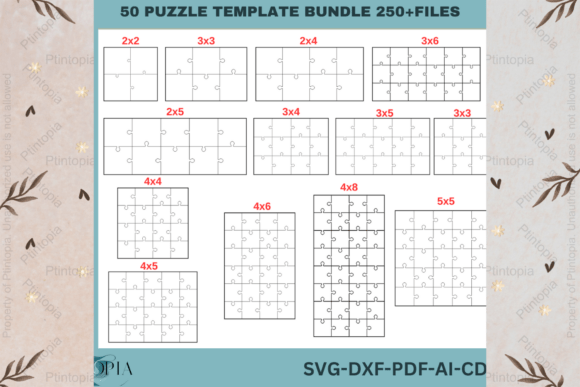
Unleash Your Inner Puzzle Master with 50 Puzzle Designs 289
A Deep Dive into the Ultimate Puzzle Template Bundle
As someone who has spent years in the trenches of design and production, I know the struggle of finding the right asset. You have a brilliant idea for a product—maybe an educational toy, a branded corporate gift, or a unique piece of merchandise for your Etsy shop—but the execution hits a wall. Sourcing high-quality, cut-ready files is often a nightmare of tracing errors and incompatible formats. That friction stops creativity cold. This is exactly the problem the 50 Puzzle Designs 289 bundle was built to solve.
Let’s be clear: this isn't just a random collection of shapes. This bundle represents a massive shift in how creators can approach custom manufacturing. We are talking about 50 unique puzzle templates accompanied by over 250 files. That kind of volume isn't just about quantity; it’s about versatility. Whether you are a small business owner looking to diversify your inventory or a crafter wanting to make personalized gifts, having a library of ready-to-go designs changes the game.
The Anatomy of the Asset: Why Format Matters
When we talk about design assets, the visual is only half the story. The real value lies in the technical execution. The 50 Puzzle Designs 289 bundle excels here because it understands the workflow of modern makers. You aren’t just getting static images; you are getting a comprehensive toolkit.
The bundle includes SVG, DXF, AI, PDF, and CDR file formats. Why does this matter? It ensures maximum compatibility across the board. If you are running a laser cutting machine like a Glowforge, Xtool, or Omtech, you need clean vector paths. If you are working in Adobe Illustrator or AutoCAD to tweak the designs for a specific packaging layout, these files are ready for you. Even if you prefer open-source solutions like Inkscape or specialized software like LightBurn, the integration is seamless. This level of compatibility removes the technical barriers that usually force designers to spend hours re-drawing files.
Visual Characteristics and Creative Personality
Visually, puzzle designs hold a unique place in our psyche. They are inherently tactile and engaging. The 50 Puzzle Designs 289 collection offers a variety of sizes and piece counts, which allows you to control the complexity of your final product. You can select a design that matches the intended "personality" of your project.
For instance, a puzzle with fewer, larger pieces creates a bold, playful aesthetic—perfect for children’s educational tools or arts and crafts projects. It feels accessible and fun. Conversely, a high piece-count design with intricate interlocking shapes conveys a sense of challenge and sophistication. This style works exceptionally well for therapeutic activities aimed at adults or premium personalized gifts that require patience and focus. The versatility of these templates means you aren't locked into one specific vibe; you can curate the experience based on your audience.
Practical Applications: From Education to Branding
So, how do you actually use 50 Puzzle Designs 289 in the real world? The applications are broader than you might think.
- Educational Puzzles: Teachers and homeschoolers can create custom learning aids. Imagine a history puzzle where students assemble a map, or a biology puzzle featuring animal anatomy. The tactile nature of puzzles aids memory retention.
- Small Business Products: If you run a print-on-demand service or a local gift shop, custom puzzles are a high-margin product. You can apply your own artwork—landscapes, abstract art, or branding elements—onto these templates to create inventory that stands out.
- Therapeutic and Recreational: There is a growing market for mindfulness tools. Creating puzzles designed for stress relief, using calming imagery, can be a niche product that serves a genuine need for cognitive exercise.
Strategic Implementation for Designers and Entrepreneurs
For the marketer or brand strategist, these templates offer a clever way to build engagement. A puzzle is not a passive object; it requires interaction. You can use these designs to create interactive direct mail campaigns, unique business cards (for the bold designer), or promotional items that actually get kept and used.
When integrating these designs into your workflow, consider the visual hierarchy of your final piece. The puzzle lines themselves become part of the design. If you are placing a photo or illustration inside the template, ensure the focal points don't get lost in the piece separations. The 50 Puzzle Designs 289 files are structured to be clean, but as a creator, you need to treat the cut lines as a layer of your composition.
Evaluating Fit and Final Thoughts
Choosing the right asset comes down to compatibility and vision. Does the style of the puzzle match your brand identity? If you are a modern, minimalist brand, you might choose a puzzle with geometric, clean lines. If you are a vintage or whimsical brand, a classic jigsaw style fits better.
Before committing to a production run, always test a single unit. Load the SVG or DXF file into your software, apply your artwork, and do a test cut on cardboard or scrap wood. Check the piece fit. In my experience, the tolerance of the cut is just as important as the visual design. A puzzle that is too tight or too loose ruins the user experience.
Ultimately, the 50 Puzzle Designs 289 bundle is a robust utility for anyone in the creative space. It bridges the gap between a digital idea and a physical product. Whether you are making a gift for a friend or scaling up a product line, having 50 distinct, production-ready designs at your fingertips provides the creative freedom to build, iterate, and innovate without starting from scratch.